
Driving the Future of ADAS through High-Performance Thermal Solutions

Advanced Driver-Assistance Systems (ADAS) are transforming modern mobility – powering autonomous features, real-time perception, safety algorithms, and high-speed computing that must operate flawlessly in all environments. But as automakers push toward higher compute density and centralized architectures, the thermal burden on these AI processors has never been greater.
Heat has become one of the most critical constraints in next-generation ADAS design. That's exactly where Solstice Advanced Materials delivers a next-generation solution. From chip to enclosure, we turn heat into a controlled pathway, not a risk.
The Thermal Challenge Behind ADAS Computing
Today's ADAS Electronic Control Units (ECUs) run extremely hot due to heavy and continuous workloads. Modern vehicle architectures shift from many distributed ECUs to centralized computing, resulting in high computing density in confined spaces. Unlike traditional ECUs that dissipated only a few watts, today's systems operate at data-center-like power densities but are designed to be as compact and efficient as possible. Heat transfer is no longer driven by air — it is driven by material pathways. It creates a growing need for better, more effective ways to move heat out of these systems and keep them running safely and reliably.
Thermal management in ADAS is a real challenge as they are subjected to rapid temperature swings, constant vibration, and must meet zero-defect automotive reliability expectations.
This harsh environment puts tremendous stress on conventional thermal interface materials. Without a robust thermal strategy, systems can experience rising junction temperatures, degraded compute performance, early aging, or even catastrophic failures.
In modern ADAS architecture, thermal management is a critical design priority, not an afterthought. Optimizing ADAS thermal performance requires early, physics-driven engineering decisions. By seamlessly integrating thermal interface materials and heat spreaders at the system level, Solstice positions itself as a strategic thermal solutions partner – enabling clients to achieve lower junction temperatures and uphold the highest standards of automotive reliability and manufacturability.
Solstice's Advanced ADAS Thermal Solution
To overcome these challenges, Solstice partnered from the silicon level with a leading automotive AI computing customer to co-engineer a complete thermal architecture tailored for next-generation full vehicle-level ADAS systems.
The integrated solution combines three robust components to systematically address localized hotspots and enhance the effective dissipation area.
High-Performance Phase Change Material (Solstice PTM Series)
Applied as TIM 1.5 directly on the bare die, Solstice PCM offers:
- Thin bond line & low contact resistance
- Optimal surface wetting
- Exceptional mechanical compliance
- Strong resistance to pump-out and degradation
- High reliability under extreme temperature cycling
Customized Heat Spreader
Solstice Heat Spreader is designed to maximize heat spreading across the thermal stack and ensure uniform surface contact.
- Optimized material selection: Evaluate high-thermal-conductivity materials aligned with customer requirements for reliability, weight, and coefficient of thermal expansion (CTE).
- System-level thermal integration: Co-design the heat spreader as an integral part of the overall cooling architecture — including cold plates, liquid cooling, or air cooling — to minimize total thermal resistance.
- Performance-to-weight optimization: Balance heat-spreading efficiency, thickness, and mass to meet customer's packaging constraints and vehicle efficiency targets.
- Manufacturable and scalable design: Enhance compatibility with high-volume automotive manufacturing processes, supporting cost, quality, and supply-chain scalability.
- Reliability and platform scalability: Work closely with customers to validate durability under automotive thermal cycling, vibration, and mechanical stress conditions, while enabling reuse across future vehicle platforms.
High Conformability Gel TIM2
Placed between the heat spreader and the cold plate, this Solstice gel ensures:
- Low contact resistance
- Excellent wetting to interfaces
- Long-term stability under vibration and load cycling
- Room temperature cure or fast cure under heating
- Low assembly stress
- High thixotropy
Combined, these materials create a multi-layer, highly optimized thermal pathway engineered for ADAS compute loads.
Real-World Results: Lower Junction Temperatures, Higher Reliability
Solstice validated this integrated solution through its in-house Thermal Test Vehicle, where the Solstice PCM delivered a significant reduction in junction temperature compared to stacks without PCM.
Lower junction temperature directly translates to higher sustained compute performance, longer component lifetime, reduced risk of thermal throttling, and fewer system-level failures.
For autonomous and ADAS systems – where safety and real-time response are non-negotiable, this is a game-changer.
Automotive-Grade Reliability You Can Trust
Solstice's portfolio is built for the toughest automotive conditions: extreme heat, rapid cycling, high humidity, vibration, shock, and chemical exposure. The flagship Solstice PTM 7900 material passes every major AEC-Q qualification category, including thermal shock, humidity, storage stability, mechanical stress, and corrosive gas exposure.
This makes Solstice's materials ideal for:
- Autonomous domain controllers
- Centralized vehicle compute
- High-power ADAS processors
- In-cabin and under-hood digital control units
With ADAS platforms expected to operate flawlessly for 10–15 years, Solstice ensures components stay cool, stable, and reliable over the full vehicle lifetime.
Designed for the Future of High-Power Automotive Electronics
Solstice offers one of the industry's most comprehensive ranges of thermal materials – covering thin bond line PCMs, gel TIMs, gap pads, and hybrid fillers tailored for diverse ADAS and EV power densities.
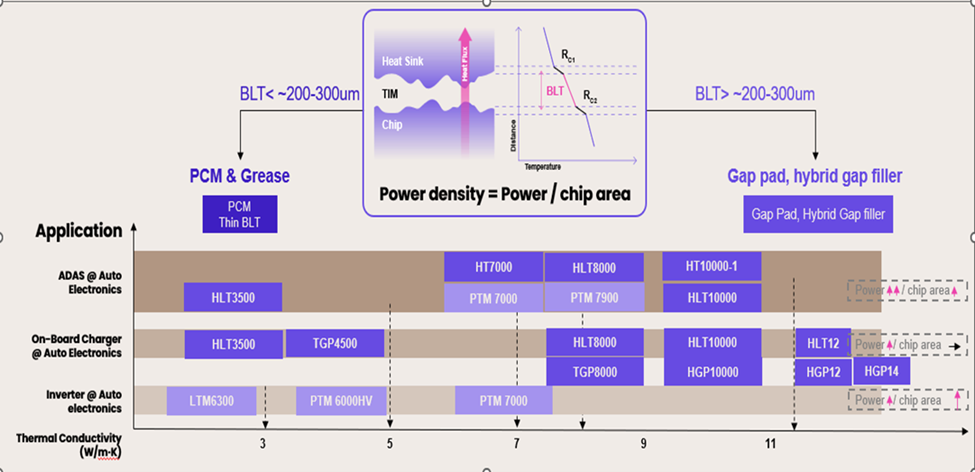
Solstice has a ready-to-deploy solution whether your design requires:
- Thin thermal interface
- Compliance for larger tolerances
- Materials compatible with automated production
- Proven reliability in severe environments
Why Leading ADAS Innovators Choose Solstice
- From silicon die to full vehicle integration, thermal materials are engineered to meet design requirements, providing consistent performance across every design level.
- Solstice offers an advanced material system engineered to minimize thermal resistance and maximize cooling efficiency in high-power electronic systems.
- Built for automotive-grade reliability and validated field stability in demanding ADAS and EV environments.
- Deep domain expertise drawn from a comprehensive portfolio of materials and solutions engineered for the automotive sector.
- Over 50 years in the semiconductor industry, with a robust product portfolio engineered to enhance your products’ performance and reliability across nearly every stage of fabrication and packaging.
Power the Next Generation of ADAS with Solstice
As vehicles evolve into high-performance computers on wheels, thermal management is becoming a core enabler of safety, speed, and intelligence. Solstice is committed to helping OEMs and Tier 1s build smarter, safer, more reliable autonomous systems – starting at the material level.
If your team is exploring new ADAS designs or facing challenging thermal bottlenecks, Solstice's specialists are ready to help engineer the right solution. Solstice delivers advanced thermal materials that enable high-performance ADAS systems to operate reliably in constricted, high-temperature environments, optimizing heat transfer, minimizing thermal resistance, and protecting critical compute and sensing functions.





CONTACT US
We’re here if you need us. Complete the form to connect with our team on any inquiry, including outreach to our sales or customer experience teams, tips on and troubleshooting with your portal or ecommerce profile, and to sign up for marketing communications.
Solstice Advanced Materials Inc.
115 Tabor Rd.
Morris Plains, NJ 07950