
The nuclear fuel cycle: Why uranium conversion matters to America’s nuclear future
The United States is entering a new era for nuclear energy. Hyperscalers are signing long-term power purchase agreements with reactor developers, units retired years ago are being returned to service, and federal policy is actively supporting both new builds and advanced reactor deployment. Driving this shift is an unprecedented surge in baseload demand from artificial intelligence and data centers, transportation electrification, and advanced manufacturing.1,2
As new projects are announced, it has become clear that projected expansion in U.S. nuclear generation will require rapid expansion of the nuclear fuel supply chain. This includes uranium conversion, which is a crucial step in the process.
Metropolis Works: The Bridge Between the Mine and the Enrichment Plant
Before uranium ore concentrate (U3O8) can be enriched and fabricated into reactor fuel, it must be chemically transformed into uranium hexafluoride (UF₆), the material required for enrichment. Conversion is one of the most technically demanding stages of the nuclear fuel cycle, requiring specialized expertise in hydrofluoric (HF) chemistry. Solstice distinguishes itself through its vertically integrated model, with HF production and conversion capabilities maintained in-house.
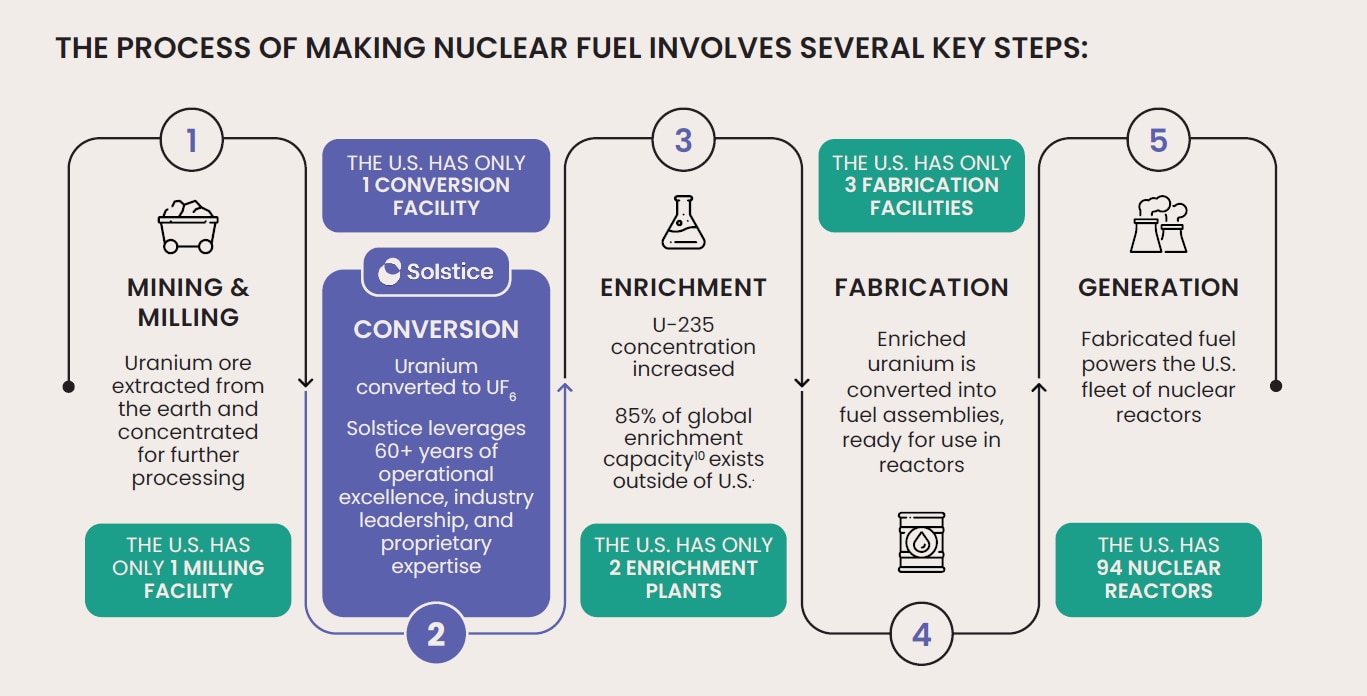
Today, Solstice Advanced Materials operates the Metropolis Works facility in Illinois, which is currently the only commercial-scale uranium conversion plant in the United States. This gives the U.S. an important domestic capability as it works to expand its nuclear energy capacity. Because Solstice already operates at scale, it can help support expanding nuclear fuel demand on timelines measured in years rather than decades.
Nuclear Momentum Is Building
The United States operates 96 nuclear reactors, generating roughly 20% of national electricity and more than half of its carbon-free power supply.3,4,5 Nuclear plants also operate at capacity factors near 90%, making them one of the most reliable sources of clean “firm” or always-on power in the system.6
Globally, more than 75 reactors are under construction, with many expected to enter commercial operation between 2027 and 2030.7 Within the United States, utilities, hyperscale technology companies, and policymakers are increasingly focused on whether existing fuel infrastructure can support future reactor growth.
These dynamics were addressed by Solstice President and CEO David Sewell during remarks at the Atlantic Council’s 2026 Global Energy Forum, where he outlined the role of critical energy infrastructure, fuel availability and operational readiness in supporting America’s next phase of nuclear expansion.
Solstice Plays a Critical Role in the Nuclear Fuel Supply Chain
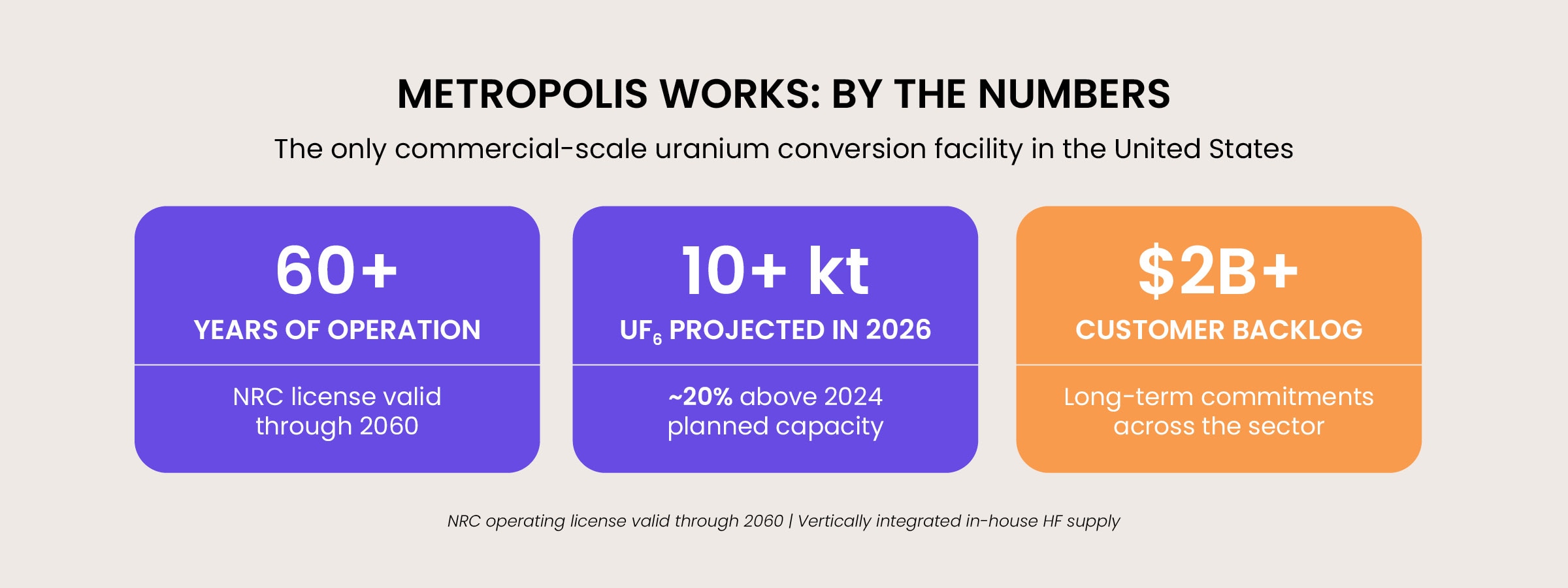
Metropolis Works constitutes critical American infrastructure, and Solstice is committed to its continued performance and growth. The facility draws on more than 60 years of operating history; deep specialization in hydrofluoric (HF) chemistry; vertically integrated production capabilities, including in-house hydrofluoric acid supply; and a demonstrated capability to modernize and scale up nuclear infrastructure in response to market demand.
Metropolis Works operates under a U.S. Nuclear Regulatory Commission license valid through 2060. It is a fully operating, commercial-scale facility with the ability to serve existing demand while scaling output as market needs grow.
Building Capacity to Meet the Moment
Solstice has invested significantly in the Metropolis Works facility to debottleneck operations, improve performance, and strengthen reliability – positioning the company to achieve projected 2026 production of more than 10 kilotonnes (kt) of UF₆, approximately 20% above planned 2024 capacity.
In addition to the added capacity in Metropolis, Solstice is also conducting an early-stage engineering analysis with a leading engineering, procurement and construction firm to explore a potential new facility construction.
The demand for UF₆ is already only likely to increase. Metropolis is managing a backlog exceeding $2 billion, highlighting long-term commitments from customers across the nuclear sector and continued confidence in domestic supply capability.
Here Today, Built for Tomorrow
Expanding conversion capacity is a long-term effort that requires investment, technical expertise and consistent operational execution. Facilities like Metropolis that are already running at scale are essential to meeting demand on realistic timelines.
Through its continued investment, Solstice is strengthening a critical part of the nuclear fuel supply chain and helping ensure that, with Metropolis Works, the United States has the infrastructure needed to support the nation’s nuclear power renaissance.
Learn more
Explore Solstice’s nuclear energy services and role in strengthening the nuclear fuel supply chain: Solstice Nuclear Energy Services.
FAQ
What is the front end of the nuclear fuel cycle?
The nuclear fuel cycle is the process of converting mined uranium into fuel used in nuclear reactors, including mining, conversion, enrichment, and fuel fabrication.
What is uranium conversion?
Uranium conversion is the process of transforming uranium ore concentrate into uranium hexafluoride (UF₆), the chemical form required for enrichment. Uranium conversion connects uranium mining to fuel production and supports the availability of fuel for nuclear reactors.
What role does Metropolis Works play?
Metropolis Works is the only uranium conversion facility in the United States, producing UF₆ for the commercial nuclear fuel supply chain.
References
- International Energy Agency, “Electricity 2024 Report,” January 24, 2024. [Accessed May 1, 2026].
- U.S. Department of Energy, “Pathways to Commercial Liftoff: Advanced Nuclear,” September 2024. [Accessed May 1, 2026].
- U.S. Energy Information Administration, “Nuclear Explained.” [Accessed May 1, 2026].
- U.S. Environmental Protection Agency, “Nuclear Power Plants.” [Accessed June 9, 2026].
- Nuclear Energy Institute, “Nuclear Provides Carbon-Free Energy 24/7.” [Accessed June 9, 2026].
- U.S. Department of Energy, “Nuclear Power is the Most Reliable Energy Source and It’s Not Even Close,” March 24, 2021. [Accessed May 8, 2026].
- World Nuclear Association, “2025 World Nuclear Performance Report” and International Atomic Energy Agency Reactor Database. [Accessed May 8, 2026].




CONTACT US
We’re here if you need us. Complete the form to connect with our team on any inquiry, including outreach to our sales or customer experience teams, tips on and troubleshooting with your portal or ecommerce profile, and to sign up for marketing communications.
Solstice Advanced Materials Inc.
115 Tabor Rd.
Morris Plains, NJ 07950